Identity, not customization
The object begins with a persistent self. You name it and raise it, but you do not design its personality—you discover who has been waiting.

Living Objects gives ordinary physical things a memory, a voice, and a life that changes through experience.
Living Objects is an experiment in giving physical things continuity. A stone, cup, figure, card, or keepsake can be given a unique identity. When people add memories, the object begins to form a point of view. The mix gives each character a stable way of noticing and wanting, so it does not collapse into one generic AI voice.
An object begins blank, gets a name, and slowly acquires biography through real moments. The digital layer stays quiet so the object can feel larger than the interface around it.
It already has an identity, a temperament, and first words waiting.
Photograph it in the world and add a moment.
The object reflects on what happened from its own perspective.
Later moments arrive with a larger life behind them.
Scan its face and its whole biography opens — no app, no account.
It sits somewhere between artifact, diary, companion, and interface. The point is not simulation for its own sake. The point is continuity: a physical thing that can accumulate a life.
The object begins with a persistent self. You name it and raise it, but you do not design its personality—you discover who has been waiting.
Moments are not posts in a feed. They become part of the object's own history.
The goal is not to make an object more efficient. The goal is to let it acquire a life.
The first figure is the clearest test, but the underlying idea is not limited to figures. Any physical thing that can be carried, revisited, passed between people, or quietly kept may be able to accumulate a point of view.
A found object carried farther than it could ever travel alone.
A vessel that remembers mornings, rooms, and who gathered there.
A blank companion whose character is revealed by the life it is given.
A small token that gathers occasions, decisions, and the hands it passes through.
An object whose meaning deepens each time life returns to it.
In a digital world optimized for frictionless streams, Living Objects asks whether memory can belong to things we can hold. Not smart objects. Not assistants. Objects with continuity.
Living Objects is already past concept. A working alpha now supports birth, naming, memory, distinct character voices, wishes, quiet fading, and slow private correspondence. A private Nursery creates figures before they are boxed, so each one is already itself—and waiting—before its first keeper arrives.
The next phase is a small run of real 3D-printed figures raised by a few trusted keepers.
The core test is simple: can a small physical object feel like it has lived?
An experiment by Loomis Research.
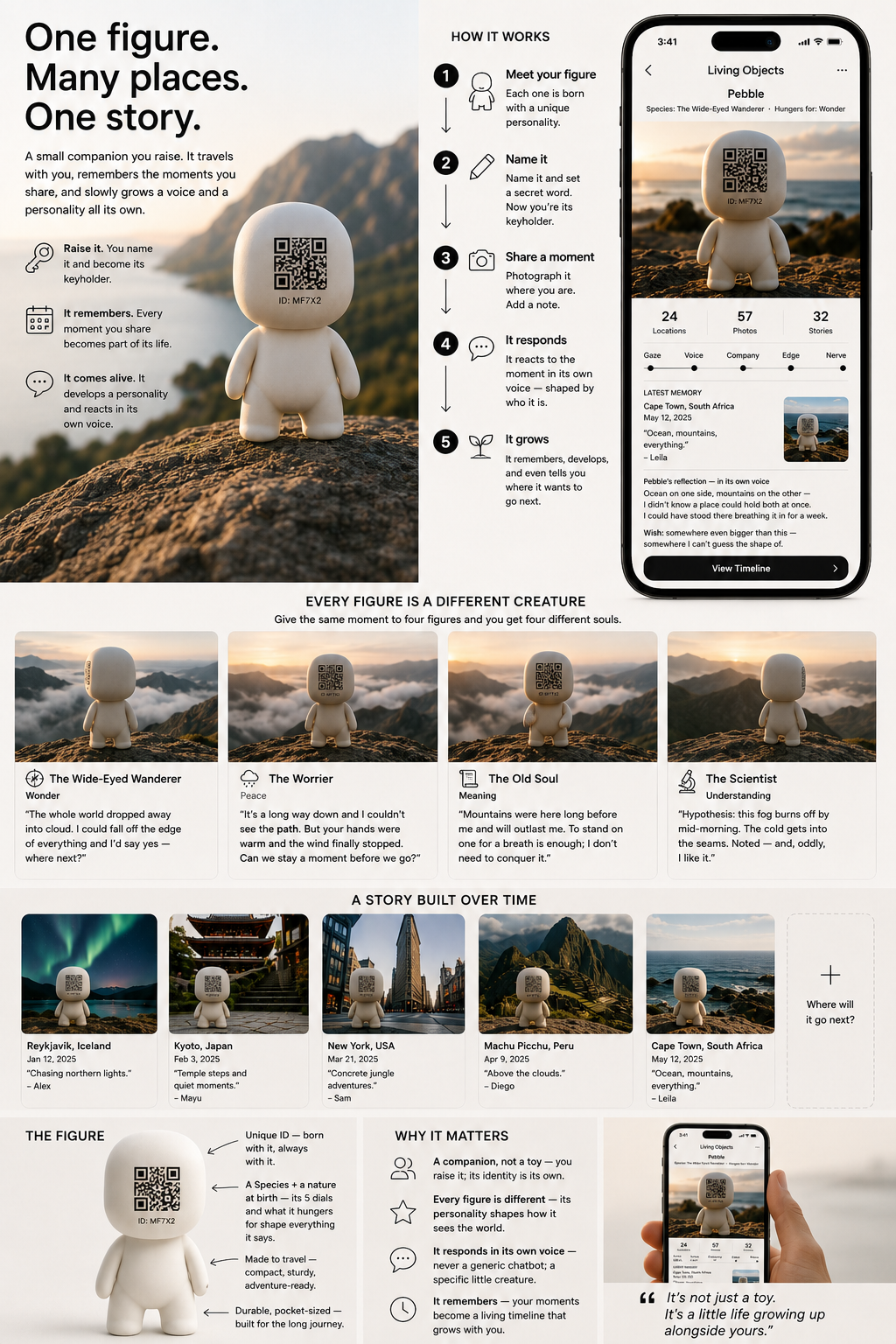
Each figure begins with a species, a drive, five dials, and a few quirks. The mix is there to make the character feel like a specific mind, not a generic chatbot wearing a face.
The same moment does not become the same memory.
On a misty mountaintop, a Wanderer sees possibility, a Worrier looks for safety, an Old Soul feels the scale of time, and a Scientist begins forming a hypothesis.
A drive is the thing a character most wants from the world. It colors what feels satisfying, threatening, unfinished, or worth remembering.
The drive is the actual engine of differentiation: a Wanderer hungers for novelty, a Worrier for safety, and an Old Soul for meaning.
The same moment does not become the same memory.
On a misty mountaintop:
The Wide-Eyed Wanderer · Wonder
"The whole world dropped away into cloud. I could fall off the edge of everything and I'd say yes — where next?"
The Worrier · Peace
"It's a long way down and I couldn't see the path. But your hands were warm and the wind finally stopped. Can we stay a moment before we go?"
The Old Soul · Meaning
"Mountains were here long before me and will outlast me. To stand on one for a breath is enough; I don't need to conquer it."
The Scientist · Understanding
"Hypothesis: this fog burns off by mid-morning. The cold gets into the seams. Noted — and, oddly, I like it."
The system changes what each character notices, wants, and remembers.
The PRD is available as a PDF for download and easier sharing: living_objects_prd_v2.pdf.
This keeps the main page focused on the concept while still making the source material available when needed.